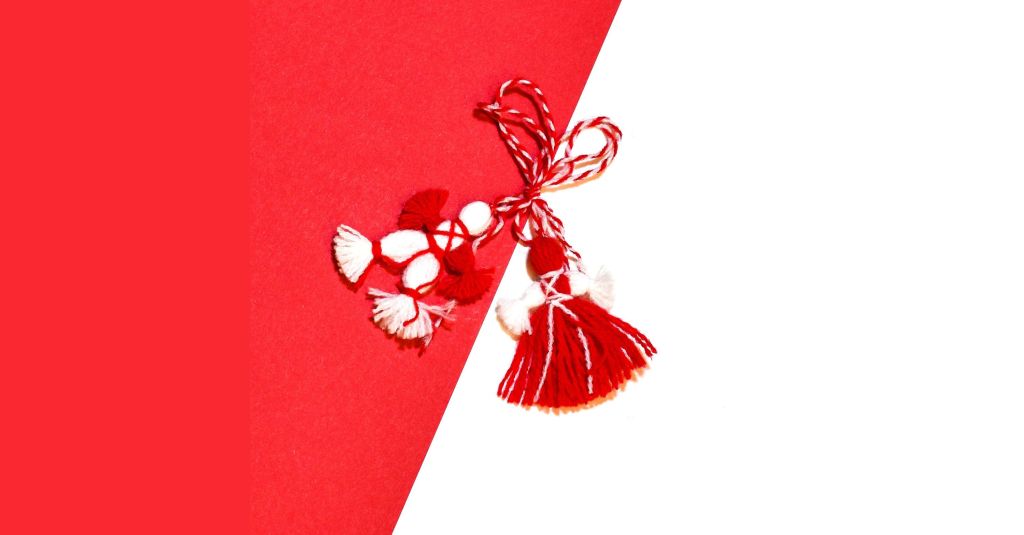
In Bulgaria, March 1st does not pass quietly.
It arrives wrapped in red and white threads, in smiles, in warm wishes for health. It is Baba Marta — a tradition that has lived for centuries and still finds its way into our hands every year.
On this day, we give each other martenitsi — small red and white threads, bracelets, or figures — as a symbol of health, strength, and the coming of spring. We pin them to our clothes or tie them around our wrists. And we smile, because we know what they mean.
Baba Marta — “Grandmother March” — is more than a name. In Bulgarian folklore, she is a strong and emotional old woman who controls the weather in March. When she smiles, the sun shines. When she is upset, the cold returns. Wearing a martenitsa is our way of greeting her, of welcoming spring, of asking for warmth.
But the magic is not only in the story.
It is in the colors.
White stands for purity, light, and new beginnings. Red stands for life, health, and strength. Twisted together, these threads carry a quiet message — that life always moves forward, that winter never stays forever.
Some legends connect this tradition to Khan Asparuh, the founder of Bulgaria in 681 AD. One story says he used a red and white thread as a signal of survival and victory. Whether legend or truth, the meaning remained — unity, resilience, hope.
For a Bulgarian living abroad, the martenitsa becomes something even deeper.
It becomes a bridge.
My mother always sends martenitsi from Bulgaria. Even when we lived in the United States, and now here in Canada, she makes sure they arrive. Because finding them here is not easy. They are everywhere back home — in markets, in shops, on street corners. But abroad, they are rare.
One year, the package was late.
March 1st came… and there were no red and white threads in our home.
So I decided to make them myself.
I sat down and twisted the threads carefully — one for my wife, one for my son, and one for me. They were simple. Imperfect. But when I gave them to my family, their eyes lit up.
It was a small moment. But it meant everything.
There was something incredibly touching about those threads. They were beautiful… yet bittersweet. For a moment, we felt so close to Bulgaria. And yet we were thousands of miles away.
That is the magic of Baba Marta.
It is not just tradition. It is connection.
For Bulgarians abroad, receiving a martenitsa in the mail feels like a warm embrace from home. It says, “You are remembered.” It says, “You still belong.”
And then comes another beautiful part of the ritual.
We wear the martenitsa until we see the first sign of spring — usually a stork or a blossoming tree. When that moment comes, we remove it and tie it to a branch or place it under a stone.
It is a quiet goodbye.
A thank you.
A return of the blessing back to nature.
Even here in Canada, far from the Balkan mountains, we follow this ritual. We look for that first sign of spring. We tie the threads to a tree. And for a second, the distance disappears.
Because traditions travel with us.
They live in our hands. In our memories. In the stories we tell our children.
Baba Marta is simple. Just two colors twisted together.
But inside those threads live generations. Folklore. History. Mothers sending packages across oceans. Fathers making martenitsi at kitchen tables. Children learning where they come from.
Traditions like this are not old customs.
They are living stories.
And on March 1st, when we say, “Happy Baba Marta,” we are not just wishing health.
We are keeping something alive.
Happy Baba Marta.
May your year be filled with health, light, and the quiet strength of tradition.
GK

 Georgi Kisyov – Reflections & Books