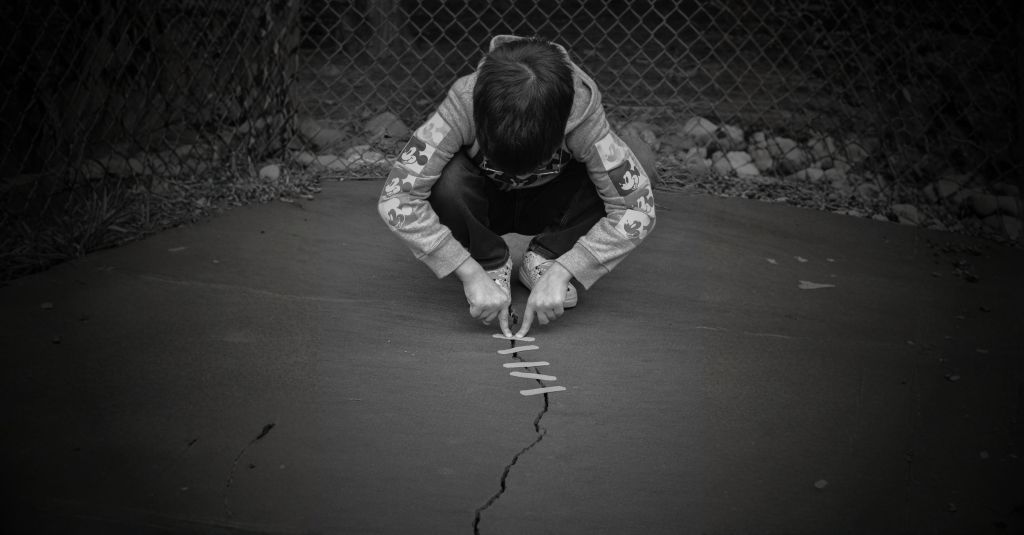
I took this photo years ago, but it still speaks to me.
It’s my son — crouched low, studying a crack in the ground.
Not rushing past it.
Not pretending it isn’t there.
Just trying to understand it.
At first glance, it’s a simple moment. A child on a playground. Concrete beneath him. A thin, uneven line running through the surface like a fault line. But the longer I look at it, the more I realise this image isn’t really about a crack in the ground at all.
It’s about how we look at the world before we learn to hurry through it.
What stays with me is not the crack —
but the instinct.
The quiet urge to fix, to connect, to bring broken lines closer together. My son didn’t see something ugly or inconvenient. He didn’t see damage. He saw a puzzle. A question. Something unfinished that deserved attention.
There was no impatience in his posture. No sense that this moment was wasting time. His whole body was involved in looking. Knees bent. Head lowered. Fingers carefully placed, as if the ground itself were speaking and he was listening closely.
Somewhere along the way, many of us lose that patience.
We learn to walk around the cracks instead of noticing them.
To step over them without asking how they got there.
To move on instead of staying.
Life teaches us efficiency early. Keep going. Don’t stop. Don’t linger. Don’t get distracted by small, broken things. We’re taught that attention should be reserved for what’s useful, profitable, productive. Cracks are none of those. They slow us down. They interrupt the surface we prefer to believe is smooth.
So we avoid them.
But children don’t yet know which things are supposed to be ignored.
They kneel where we walk.
They stop where we rush.
They look where we glance.
Looking at this image now, I realise how much I miss that way of seeing. That slow attention. That natural belief that even broken things deserve care — not because they can be fixed, but because they exist.
There is something deeply human in the desire to bring pieces together. To close gaps. To soften breaks. It shows up early, before it becomes complicated by disappointment or fear. Before we learn that not everything can be repaired, and that some attempts will fail.
As adults, we carry cracks of our own.
In relationships.
In memories.
In plans that didn’t turn out the way we imagined.
And over time, many of us develop a survival skill: we stop looking too closely. We learn how to keep moving without asking hard questions. We tell ourselves it’s easier that way. Less painful. More practical.
But there’s a cost.
When we stop noticing cracks, we don’t just avoid discomfort — we lose intimacy. With others. With the world. With ourselves. The careful attention that once came naturally starts to feel risky, even unnecessary.
This photograph reminds me that attention is not weakness. It’s not inefficiency. It’s a form of care.
My son wasn’t trying to fix the ground so it could be perfect again. He was trying to understand what had happened there. He was responding to the world as it was, not as it should have been.
That matters.
Because so much of our adult frustration comes from wishing things were different instead of meeting them where they are. We want smooth paths, clean lines, clear answers. And when reality offers cracks, we label them as failures instead of invitations.
Maybe that’s what photography has always been for me.
Not the camera.
Not the technical side.
Not the image itself.
But the way it taught me to look.
Photography asked me to slow down. To notice what others passed by. To see meaning in small, ordinary moments. It trained my eyes — and eventually my heart — to stay a little longer with things that didn’t immediately make sense.
This image doesn’t need an explanation. It doesn’t need a lesson neatly wrapped at the end. It simply holds a truth I don’t want to forget:
That care often begins with stopping.
That connection starts with attention.
And that sometimes, the most important thing we can do is kneel down and really look at what’s in front of us — even when it’s cracked.
Especially then.
GK

 Georgi Kisyov – Reflections & Books
How tender and reflective. A beautiful recollection of a moment in time and what can be learned. Thank you for this reminder.
LikeLiked by 3 people
Thank you so much. It really was one of those quiet moments that stays with you long after it passes. I’m glad it resonated with you — reminders like this feel especially important to hold onto.
GK
LikeLiked by 2 people
Beautiful!
LikeLiked by 1 person
Thank you so much. Have a wonderful day.
GK
LikeLiked by 1 person
My thanks as well. This is a beautifully expressed reminder to slow down and look.
LikeLiked by 1 person
Thank you. Slowing down and really looking feels like something we all need reminders for now and then.
I’m glad the words found their way to you.
GK
LikeLike
I need to read this again, Georgi. At this moment it really speaks to me.
LikeLiked by 1 person
That means a lot 🤍
I believe some words arrive exactly when we need them — and sometimes they ask to be read more than once. I’m glad this one found you in this moment.
GK
LikeLike
” to stay a little longer with things that didn’t immediately make sense”
That wonder and reasoning to work with what they see, not what it should be or want it to be because they don’t know yet, you’ve captured this so well with the picture and words. Another tug on the heart ~ Rosie
LikeLiked by 2 people
Rosie, thank you 🤍
You said this so beautifully — working with what they see, not what it should be. That’s exactly it. Before expectations arrive, there’s only presence and curiosity. I’m grateful you felt that in both the image and the words.
GK
LikeLiked by 1 person
Thank you for this. I know I don’t notice those small things.
LikeLiked by 1 person
Thank you for sharing that.
I think many of us feel the same — noticing comes and goes. Sometimes, simply realizing it is already a small, meaningful step.
GK
LikeLike
What a beautiful post. I really enjoyed reading it.
LikeLiked by 1 person
Thank you 🤍
I’m really glad you enjoyed it — that means more than you know.
GK
LikeLiked by 1 person
Beautiful! This reminds me of the Japanese art of Kintsugi–honoring the cracks, the accidents in life and in objects, gluing things back together and painting the cracks gold. ❤
LikeLiked by 1 person
Yes 🤍 that’s such a beautiful connection. Honoring the cracks instead of hiding them changes everything — in objects, and in us. Thank you for bringing Kintsugi into this moment.
GK
LikeLike
I’ve got to say Georgi, you are on a roll. Thses last two post… powerful reflections! This really stayed with me, in fact I read through it twice because I just wanted to soak in the moment. There’s something about that image—your son kneeling instead of stepping over—that feels like a mirror held up to adulthood. Somewhere along the way, we learn to keep moving, to stay upright, to avoid anything that might slow us down. And yet here he is, lowered, unhurried, giving his full attention to something small and imperfect… and it feels quietly holy.
What struck me most is the thought that attention itself is a form of care. Not fixing. Not resolving. Just staying long enough to see. I realize how often I move past cracks— in people, in moments, even in myself—because I’ve learned that lingering feels inefficient or risky. But this reminds me that connection doesn’t begin with answers; it begins with presence.
There’s a profound tenderness in the idea that children meet the world as it is, not as it should have been. Maybe that’s what we’re always trying to recover—not innocence, but the courage to kneel again. To believe that broken places aren’t interruptions, but invitations.
LikeLiked by 1 person
I’m deeply touched by this — thank you. The way you described it as a mirror held up to adulthood feels exactly right. And yes… attention as care, without fixing or resolving — just staying. That might be one of the bravest things we can do. I’m grateful you knelt with the image and the words for a while.
GK
LikeLike
“The most important thing we can do is kneel down and really look at what’s in front of us — even when it’s cracked.’’. Thanks!
LikeLiked by 1 person
Thank you.
I’m glad that line stayed with you — sometimes it’s the simplest gestures that ask the most of us.
GK
LikeLike
Superb post, Georgi xx
LikeLiked by 1 person
Thank you so much. I appreciate your support.
Have a wonderful day.
GK
LikeLiked by 1 person
Beautifully expressed! 😌
LikeLiked by 3 people
Thank you so much. I wish you a wonderful day.
GK
LikeLiked by 1 person
Beautiful. A reminicence that woke a depth of understanding and really, accountability. Your right though, life passes like the blink of an eye and before you know it, all that was is gone. This heartwarming reflection encourages each of us to take a moment, pause, breath, and even if we cant fix the crack acknowledge its presence and face our own inability… that we arent mean nor can we fix everything. Ackowledgement is enough in thus ibstance. Sometimes the crack is the lesson and its meant for us. As a whole, we are encouraged rewarded for plodding on, for constantly moving step after step unfalteringly giving to the machine without stopping to smell the roses learn the valued lessons along the way. Wonderful to be given a second chance to reflect and cherish later. Doubly treasured. By us now, too.
LikeLiked by 1 person
I really like your reflections. You add something beautiful to the conversation. Thank you for the reading. Have a calm evening.
GK
LikeLike