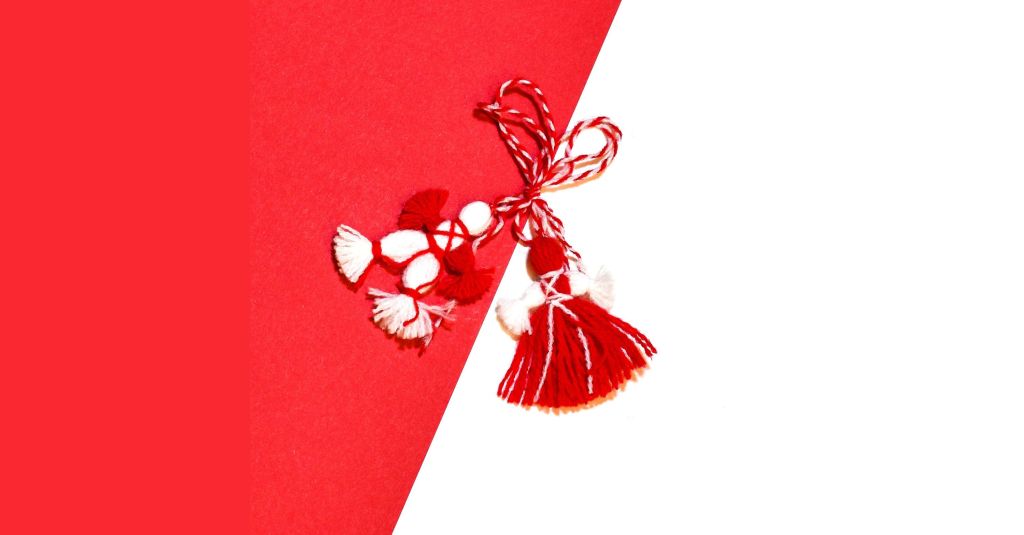
In Bulgaria, March 1st does not pass quietly.
It arrives wrapped in red and white threads, in smiles, in warm wishes for health. It is Baba Marta — a tradition that has lived for centuries and still finds its way into our hands every year.
On this day, we give each other martenitsi — small red and white threads, bracelets, or figures — as a symbol of health, strength, and the coming of spring. We pin them to our clothes or tie them around our wrists. And we smile, because we know what they mean.
Baba Marta — “Grandmother March” — is more than a name. In Bulgarian folklore, she is a strong and emotional old woman who controls the weather in March. When she smiles, the sun shines. When she is upset, the cold returns. Wearing a martenitsa is our way of greeting her, of welcoming spring, of asking for warmth.
But the magic is not only in the story.
It is in the colors.
White stands for purity, light, and new beginnings. Red stands for life, health, and strength. Twisted together, these threads carry a quiet message — that life always moves forward, that winter never stays forever.
Some legends connect this tradition to Khan Asparuh, the founder of Bulgaria in 681 AD. One story says he used a red and white thread as a signal of survival and victory. Whether legend or truth, the meaning remained — unity, resilience, hope.
For a Bulgarian living abroad, the martenitsa becomes something even deeper.
It becomes a bridge.
My mother always sends martenitsi from Bulgaria. Even when we lived in the United States, and now here in Canada, she makes sure they arrive. Because finding them here is not easy. They are everywhere back home — in markets, in shops, on street corners. But abroad, they are rare.
One year, the package was late.
March 1st came… and there were no red and white threads in our home.
So I decided to make them myself.
I sat down and twisted the threads carefully — one for my wife, one for my son, and one for me. They were simple. Imperfect. But when I gave them to my family, their eyes lit up.
It was a small moment. But it meant everything.
There was something incredibly touching about those threads. They were beautiful… yet bittersweet. For a moment, we felt so close to Bulgaria. And yet we were thousands of miles away.
That is the magic of Baba Marta.
It is not just tradition. It is connection.
For Bulgarians abroad, receiving a martenitsa in the mail feels like a warm embrace from home. It says, “You are remembered.” It says, “You still belong.”
And then comes another beautiful part of the ritual.
We wear the martenitsa until we see the first sign of spring — usually a stork or a blossoming tree. When that moment comes, we remove it and tie it to a branch or place it under a stone.
It is a quiet goodbye.
A thank you.
A return of the blessing back to nature.
Even here in Canada, far from the Balkan mountains, we follow this ritual. We look for that first sign of spring. We tie the threads to a tree. And for a second, the distance disappears.
Because traditions travel with us.
They live in our hands. In our memories. In the stories we tell our children.
Baba Marta is simple. Just two colors twisted together.
But inside those threads live generations. Folklore. History. Mothers sending packages across oceans. Fathers making martenitsi at kitchen tables. Children learning where they come from.
Traditions like this are not old customs.
They are living stories.
And on March 1st, when we say, “Happy Baba Marta,” we are not just wishing health.
We are keeping something alive.
Happy Baba Marta.
May your year be filled with health, light, and the quiet strength of tradition.
GK

 Georgi Kisyov – Reflections & Books
Thank you for telling me about this. What a beautiful thing to do and how lovely to have a strong grandmother at the heart of the month.
This year I have enjoyed gentle, rainy, grey February so much I’m sorry to see it go. I tend to find March bright and harsh, but today I will greet her with thanks and hope.
Happy Baba Marta.
LikeLiked by 4 people
Thank you for receiving it with such openness. I love how you described February — gentle, rainy, grey. There is something comforting about that softness. March can indeed feel brighter, even a little sharp at first… perhaps Baba Marta is simply stretching after winter.
I hope she arrives gently for you this year — with light that warms, not overwhelms.
Happy Baba Marta. 🌿
GK
LikeLiked by 3 people
What a lovely tradition 🤗
Happy Baba Marta ☺
LikeLiked by 4 people
Happy Baba Marta to you, too.
Have a wonderful Sunday.
GK
LikeLiked by 3 people
That’s a nice tradition! May you and your family have a wonderful time.
LikeLiked by 3 people
Thank you so much 🤍❤️
It truly is a beautiful tradition, and I’m grateful we can carry it with us, even far from home. Wishing you a wonderful day as well — filled with light, health, and a little sign of spring. 🌿
GK
LikeLiked by 3 people
I love that I learn so much from my circle here. Thank you for this gift and thank you for sharing Baba Marta. 🤍❤️
LikeLiked by 3 people
That’s such a beautiful thing to say — thank you. 🤍❤️
It means a lot to me that you receive these traditions with such openness. Sharing Baba Marta feels like sharing a small piece of home, and knowing it’s welcomed here makes it even more special. Grateful you’re part of this circle.
GK
LikeLiked by 3 people
I’m so thrilled to learn each day! Looking forward to your next piece!
LikeLiked by 2 people
What a beautiful tradition. Thank you for sharing this!
LikeLiked by 3 people
Thank you. Have a great Sunday.
GK
LikeLiked by 1 person
Very interesting…
LikeLiked by 2 people
It is a great tradition. Have a beautiful day.
GK
LikeLiked by 1 person
Happy Baba Marta! How wonderful to remember that years ago I also got a martenitsi from a Bulgarian colleague and she told us this story. Happy I logged in and could read this post now right on the day ! Wish you all a joyous spring 💓
LikeLiked by 2 people
Happy Baba Marta! 🤍❤️
How beautiful that you already carry a small piece of this tradition in your memory. I love that it found you again today, right on March 1st — sometimes timing feels like its own little blessing.
Wishing you a joyous spring as well — full of light, renewal, and small meaningful moments. 🌿
GK
LikeLiked by 2 people
I have never heard of this before, what a wonderful thing to share with everyone! So fitting for today with warmer temps earlier in the day, sunshine, and birds singing. By afternoon, the chill in the wind was back and there’s snow in the forecast tomorrow! So Happy Baba Marta to you as well! ~ Rosie
LikeLiked by 1 person
Oh Rosie, that sounds exactly like Baba Marta at work. 🤍❤️
In our folklore, she is known for changing her mood quickly — sunshine in the morning, cold wind by afternoon. When she smiles, it feels like spring. When she frowns, winter reminds us it’s not quite finished.
Your day sounds like a perfect example of her personality. 🌤️❄️
I’m so glad you enjoyed learning about this tradition. It makes me happy to share a small piece of Bulgaria here.
Happy Baba Marta to you as well — may the sunshine linger a little longer tomorrow. 🌿
GK
LikeLiked by 1 person
I love this so much! This day has felt like it should be one of meaning, but here where I live there does not seem to be any. I’m so grateful to hear about your lovely tradition, and I’m grateful for your creativity in carrying it on 🥰
LikeLiked by 2 people
That’s such a beautiful thing to say — thank you. 🤍❤️
I think some days do carry a quiet meaning, even if no one around us names it. Sometimes we just need a story, a symbol, or a small ritual to bring it to life.
It means a lot that you received this tradition so openly. And truly, carrying it on isn’t creativity as much as love — love for where we come from, and for the people we share it with.
Grateful you’re here to share in it. 🌿
GK
LikeLiked by 1 person
You have a way of getting stuck in someone’s head with your writing and having them ponder your words. It’s powerful. And so impactful.
LikeLiked by 1 person
That means more than you know — thank you. If my words stay with someone even a little longer than the moment they’re read, then I feel I’ve done something right. I don’t write to impress — I write to connect, to stir something honest and real.
Grateful that it resonated with you. 🌿
GK
LikeLiked by 1 person
What a fine story!
LikeLiked by 1 person
Thank you so much. I’m glad that you liked it.
Have a great evening.
GK
LikeLike
I love how something as simple as two threads can carry so much meaning. It reminds me how traditions quietly hold pieces of home for us—little reminders of where we come from and the people who shaped us. Even small rituals like that can become anchors, connecting past and present in ways that words sometimes can’t.
LikeLiked by 1 person
You said that beautifully — thank you. 🤍❤️
I love the way you described traditions as anchors. Sometimes the smallest things — like two simple threads — can carry memories, places, and people within them.
It’s amazing how these little rituals quietly keep the past and present connected. I’m grateful the story resonated with you. 🌿
GK
LikeLike