There is a certain kind of silence that belongs only to summer afternoons.
Not the soft silence of early morning, when the world is still waking up. Not the peaceful silence of evening, when the day folds itself gently away. This is a different silence. A hot, bright, almost shimmering silence that arrives sometime after lunch, when the sun is standing high above everything, and even the birds seem too tired to sing.
At noon in summer, the playground is often empty.
The slide is too hot to touch. The metal bars burn like they have been holding the whole sun inside them. The sandbox lies undisturbed. Somewhere, far away, you can hear the lazy sound of a lawnmower or a dog barking once and then giving up. The world feels paused, as if someone has pressed a finger gently against the middle of the day and asked it to stand still for a moment.
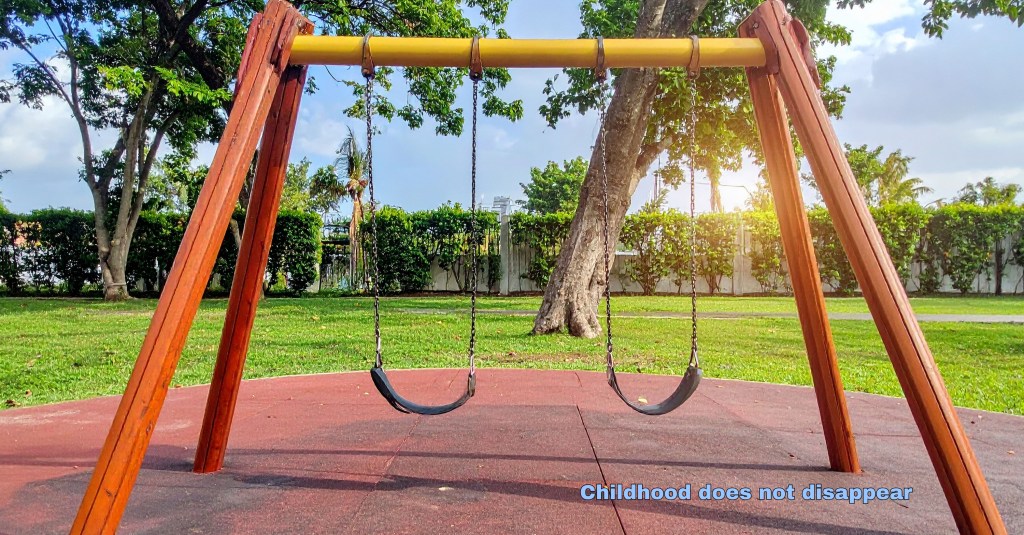
And there, in the middle of all that stillness, hangs the swing.
Sometimes it moves a little in the breeze. Not enough to swing, only enough to remind you that it once did.
I think every empty swing carries two things at the same time: silence and memory.
The last time I was in Bulgaria, I walked through the neighborhood where I grew up. My parents still live there, and when I visit, I always feel as if I am walking through two places at once. One is the neighborhood that exists now, with older buildings, different faces, quieter streets. The other is the neighborhood that still lives inside me, full of children, bicycles, shouted names, scraped knees, and long summer days that seemed as if they would never end.
Without planning to, I found myself standing in front of the old playground.
It was smaller than I remembered. Childhood has a strange way of making everything seem larger. The trees looked shorter. The distance between the swings and the slide looked smaller. Even the old bench where parents used to sit seemed different.
But the swing was still there.
The same little swing I loved when I was a child.
It hung quietly in the noon heat, moving just a little in the wind, as if it had been waiting all these years for someone to come back.
For a moment, I felt sadness so sudden and deep that it almost surprised me.
I remembered the friends who used to stand beside me there. I remembered the games we played. I remembered arguing about whose turn it was and pretending not to count properly so we could stay on the swing a little longer. I remembered running across the playground with the kind of energy that only children seem to have, as if the whole world were too exciting to walk through slowly.
There are people from childhood whose names still live inside us like little songs. We may not see them anymore. We may not even know where life carried them. But one empty swing, one street, one afternoon filled with heat and silence, and suddenly they are standing beside us again.
For a few minutes, I stood there and missed everything.
I missed my friends. I missed the noise. I missed the feeling that summer would last forever.
Perhaps that is one of the strangest things about growing up. We do not only lose people or places. We lose versions of ourselves. The child who ran toward the swing without thinking. The boy who believed that every summer afternoon would repeat itself forever. The one who could not imagine that one day he would come back alone.
Summer is usually described as the happiest season. We fill it with bright words: laughter, sunshine, freedom, vacations, ice cream, beaches, long evenings. And it is all of those things.
But summer also has its own loneliness.
Especially at noon.
Because noon is the hour when everything is too bright to hide. The empty places are easier to see then. The empty chair on the porch. The quiet room. The friend who moved away. The person we used to be.
There is something about an empty playground in summer that feels almost like a photograph left too long in the sun. The colors are still there, but softer now. Faded around the edges. Beautiful because they are disappearing.
I think that is why the empty swing made me sad.
Not because the playground was empty, but because it was full.
Full of everything that had happened there.
Memory does not leave places as easily as people do. It stays. It sits quietly on the corners of old streets, in the smell of warm grass, in the crack in the sidewalk, in the swing that still moves a little in the breeze.
And then, just as I was standing there, feeling all of this, another memory came to me.
Before we left Bulgaria, I had brought my son to that same playground.
He had played there. He had laughed there. He had sat on that same swing.
Suddenly, the sadness changed.
Because I realized that the swing had not only held my childhood. It had held his too.
The same chains. The same seat. The same small arc through the summer air.
Somewhere between my hands and his, between the little boy I once was and the father I have become, the swing continued carrying childhood forward.
And I understood something beautiful.
Our childhood does not disappear.
It waits for us in certain places.
It waits quietly in old playgrounds and familiar streets. It waits in songs, in smells, in photographs, in the evening sky over a neighborhood we once knew by heart.
And sometimes, if we are lucky, it waits for us in a swing.
Not to make us sad forever. Not to remind us only of what is gone. But to whisper: You were here. You loved this. This mattered.
The swing was empty when I saw it.
But perhaps empty places are never truly empty.
Perhaps they are simply places where memory still sits, waiting for us to come back and say, “Hello. I remember you.”
GK


This brought back a feeling I know very well. About ten years ago, I returned to the hometown where I grew up, a place I had left some fifty years earlier. I expected things to look different, of course, but I wasn’t quite prepared for how it would feel to stand there again.
It is a strange thing to walk through a place with two sets of eyes—the eyes you have now and those of the child who still remembers exactly how everything used to be. Streets seemed smaller, distances shorter, and places that had once felt enormous were suddenly rather ordinary. Apparently childhood comes equipped with its own magnifying glass.
But what surprised me most was how quickly memory filled in what time had removed. I could almost see the people who had once been there and remember things I hadn’t consciously thought about in years. It made me realize that we don’t simply remember places; somehow we carry whole little worlds inside us, complete with voices, faces, sounds, and versions of ourselves that existed there.
Perhaps that is why returning can feel both wonderful and achingly sad. We go back looking for a place and discover that what we are really visiting is a piece of our own story. We cannot step back into it, but for a few moments we can stand close enough to remember who we were there—and be grateful that those ordinary days became treasures before we even knew we were collecting them.
LikeLiked by 3 people
What a beautiful reflection, and I especially love your thought that childhood comes with its own magnifying glass. You described that strange feeling perfectly—walking through the same place with the eyes of the person we are now and the child we once were. And those ordinary days truly did become treasures before we ever knew we were collecting them.
GK
LikeLiked by 2 people
“Swings carry childhood forward,” how beautiful. Thank you.
LikeLiked by 3 people
Thank you so much. That thought became very special to me while writing this story. Sometimes the simplest things from childhood quietly stay with us and carry more memories than we realize.
GK
LikeLiked by 1 person
Oh, this is lovely, GK. There’s nothing quite so nostalgic as an abandoned playground. Empty, and yet so filled with the past.
LikeLiked by 2 people
Thank you so much! That is exactly what struck me that day—it looked so empty, yet somehow it felt full of voices, laughter, and memories. Some places never really become empty when a piece of our childhood still lives there.
GK
LikeLiked by 1 person
I loved that…it wasn’t empty. It was full…of memories. Such a delightful take on what once was and also true. When we visit a place from the past, it hasn’t changed for the most part, some has of course, it has to. Fundamentally, it remains the same, nothing is changed but us. Nostalgia, sure, but new light, different light different perspective but holding true to what once was while making room for the new, the new, the present. That too has great significance. What could be more profoundly touching than taking your son to this once loved much enjoyed place and share a memory of him there with you. Not overlapping or erasing but adding even more dimension. A different wonderful shared memory of you together. How heartfelt this is, Georgie, truly. You have many wonderful memories and reflections. I for one appreciate and enjoy each one. ❤️
LikeLiked by 3 people
Thank you so much for this beautiful and thoughtful reflection. I love how you said that taking my son there didn’t overlap or erase the old memories, but added another dimension to them—that is exactly what made that realization so special for me. The playground may belong to my past, but now it holds a little piece of his childhood too, and somehow that made the old swing feel even more precious.
GK
LikeLiked by 2 people
You summed up the feeling of nostalgia so well. I have been feeling nostalgic a lot recently, having moved back into my childhood neighborhood, where my now deceased sister and I grew up and made so many memories.
LikeLiked by 3 people
Thank you so much for sharing something so personal. I can imagine how many memories must surround you now that you are back in the neighborhood where you and your sister grew up together. Places can hold so much of the people we love, and sometimes simply walking through them brings those precious moments close again.
GK
LikeLiked by 2 people
“Our childhood does not disappear. It waits for us in certain places.”
Such beautiful memories, and descriptions of childhood. Just read these last few posts, sensing a time of remembering to move forward into the next season of life. Prayers my friend. ~ Rosie
LikeLiked by 1 person
Thank you so much, Rosie. I love how you connected these recent posts—perhaps there really is a little season of remembering happening in my writing right now. And maybe remembering where we have been is sometimes part of understanding where we are going next. Thank you, as always, for reading so thoughtfully and for your prayers.
GK
LikeLiked by 1 person