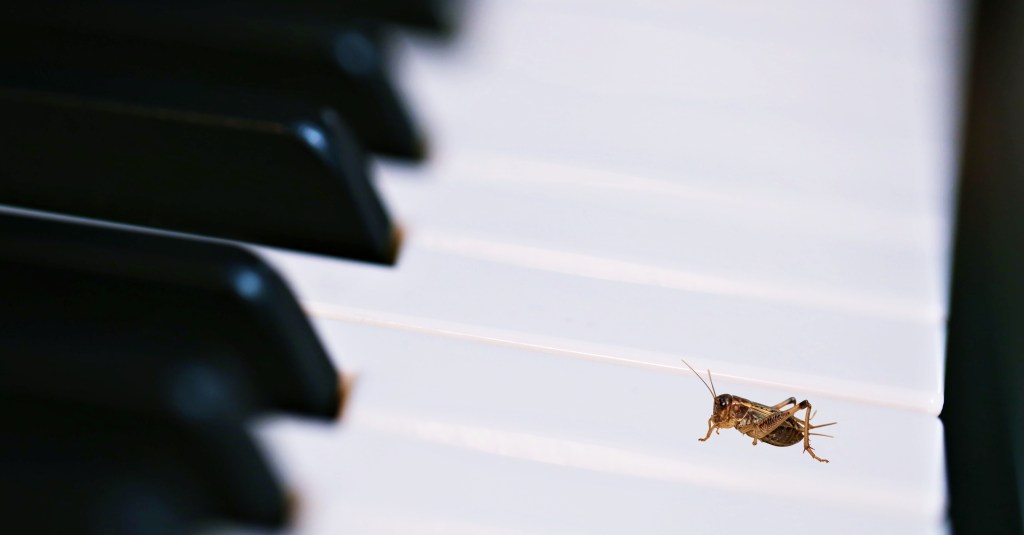
Some sounds belong to childhood the way certain smells belong to old kitchens or certain colors belong to autumn. For me, one of those sounds is the song of the crickets.
It always began the same way.
The day would slowly fold itself up. The burning heat of the afternoon would soften. The sky above the village would turn from blue to gold, and then from gold to that deep summer purple that arrives just before night. Somewhere in the tall grass, hidden where no one could see it, one cricket would begin.
Crick.
Then another.
And another.
Before long, the whole evening was full of them.
Their tiny voices rose from the fields, from the gardens, from the cracks beside the old stone wall. One little sound became hundreds, then thousands, until the night itself seemed to be singing. The crickets did not play a melody we could hum, and yet somehow it was music. A soft, steady music that wrapped around everything.
That was the soundtrack of my childhood.
In the daytime, summer belonged to us children. We spent the long vacation running through dusty streets and wild grass. We rode our bicycles until our legs hurt. We climbed trees, scraped our knees, chased each other through gardens, and stayed outside until our mothers called our names from far away.
The sun ruled those hours.
But when evening came, something changed.
The day felt slower. Softer. The world seemed to take a deep breath.
The adults sat outside in front of the house, talking quietly on benches and porches. Someone always laughed. Someone always told an old story for the tenth time. A radio played somewhere in the distance. The smell of cut grass, warm earth, and tomatoes from the garden filled the air.
And beneath all of it, always, were the crickets.
Their song was the sign that the day was not over yet.
It meant there was still time.
Still time to sit on the steps and watch the stars appear one by one. Still time to catch fireflies in a jar. Still time to stay outside just a little longer.
Most evenings, we gathered in the little park in the village. One by one, my friends appeared from different streets, riding old bicycles or running toward us before their parents could change their minds.
Even now, if I hear the crickets on a warm summer night, I can still remember their names.
I remember who always arrived first. Who laughed the loudest. Who wanted to play one more game even when it was already late.
We sat on the swings, on the old bench, or directly on the grass. We talked about everything and nothing. We told stories. We made plans we never kept. We played games until we could barely see each other in the dark.
And all the time, around us, the crickets were singing.
They were there between our laughter. Between our words. Between those long silences when we looked up at the sky and thought life would always stay exactly like this.
When I hear crickets now, I do not simply hear insects. I hear those evenings in the park. I hear the voices of my childhood friends. I hear the sound of us laughing at something that probably was not even funny.
As children, we never thought about how lucky we were. We did not know those nights would one day become memories. We thought summers would always last forever. We thought there would always be another July, another August, another evening when we could stay outside until the sky became black velvet covered in stars.
Back then, the future felt far away. There were no clocks inside childhood. Only moments.
And the crickets seemed to guard those moments.
Their song had something steady and comforting in it. It did not ask for attention the way thunder does. It did not interrupt the silence. It became the silence.
At night, when I lay in bed with the window open, I could still hear them outside. Their chirping drifted into the room together with the cool breeze. Crick-crick-crick. Over and over.
To an adult, it might have been only a small sound.
To a child, it was something else.
It was proof that the world was still awake.
Even though I was in bed, the night was alive outside my window. The trees were still standing there in the darkness. The stars were still shining above the roof. Somewhere, in the tall grass, the crickets were still singing.
Their song felt like a nightlight made of sound.
Years later, I learned the scientific explanation. Crickets make that sound by rubbing their wings together. They sing to call to one another, to find a mate, to mark their place in the world.
But I think childhood hears something different.
To a child, the crickets are not insects in the grass. They are the heartbeat of summer.
They are the voice of warm nights and open windows. They are the sound of bare feet on old wooden floors, of cool sheets after a day in the sun, of one last glass of lemonade before bed.
Maybe that is why hearing them again, even now, can pull me backward through time faster than almost anything else.
All it takes is one August evening.
The sun begins to disappear. The air grows softer. Somewhere nearby, a single cricket begins to sing.
And suddenly, I am back in my village.
I am small again. The night is enormous. The park is full of my friends. Someone is laughing. Someone is calling my name. Someone says we still have time for one more game.
There is no hurry. No noise. No endless list of things to do.
Only the warm darkness, the smell of grass, the voices of the people I loved, and the endless song of the crickets.
Perhaps that is why they still matter.
Because the crickets remind us that some of the most beautiful things in life are small. So small that we almost miss them.
A tiny black insect hidden in the grass. A summer evening in the village park. The laughter of friends whose names we still carry inside us. A moment that seemed ordinary while we were living it.
And yet years later, we realize those were the moments that built us.
The crickets are still singing the same song they have sung for centuries. The world around them has changed. We have changed.
But every summer, when the evenings grow long and the stars come out, they begin again.
As if they are gently reminding us that somewhere inside us, the child who listened is still there.
GK


Well written, you transported us to our childhood days 😊
LikeLiked by 4 people
Thank you so much! That means a lot to me. I love how a simple sound like the crickets can open the door to so many childhood memories.
GK
LikeLiked by 2 people
Simply Beautiful Georgi!
There is a fascinating little wonder tucked inside the cricket’s song: they do not sing with their mouths. The male cricket has specialized structures on his wings—essentially a tiny file and scraper—and produces that familiar chirp by rubbing them together. Even more remarkable, the rhythm of some cricket species’ chirping changes predictably with temperature, which is why people have long called crickets “nature’s thermometers.”
I rather love that God put so much engineering into something we usually hear without ever seeing. Hidden in the grass is a tiny musician carrying his instrument on his own back—and apparently giving the evening weather report while he plays it! It makes me wonder how many other marvels of God’s workmanship are performing faithfully just beyond our notice. “The works of the LORD are great, sought out of all them that have pleasure therein” (Psalm 111:2).
LikeLiked by 2 people
What a wonderful addition to my reflection! I especially love the thought of a tiny musician carrying his instrument on his own back—and giving us the weather report at the same time. 😊 Nature is full of extraordinary details hidden inside the most ordinary things, if only we slow down enough to notice them. Thank you for sharing this beautiful perspective.
GK
LikeLike
You have created more pictures of childhood summers and conjured more memories for me. How gloriously endless those summers were and full of vivid sights, sounds, smells, tastes and touches which have become life giving parts of me.
How blessed I am to have enjoyed such childhood times.
LikeLiked by 1 person
Thank you so much for sharing this beautiful reflection. “Gloriously endless” describes those childhood summers so perfectly—we lived them without realizing how deeply all those sights, sounds, smells, and little moments were becoming part of us. What a blessing it is to carry pieces of those summers with us still.
GK
LikeLike
Beautiful!
LikeLiked by 1 person
Thank you so much. Have a beautiful day.
GK
LikeLiked by 1 person
You are welcome! And thank you!
LikeLiked by 1 person
beautiful:) I can hear them.
LikeLiked by 1 person
Thank you so much! If my words made you hear the crickets for a moment, then this story did exactly what I hoped it would.
GK
LikeLiked by 1 person
They (who claim to know everything) say that the senses of smell and hearing are the strongest for evoking long forgotten memories. I think “they” are right. For me, especially sounds. You offer a series of wonderful turns of phrase about the soundtracks of our childhood and sultry summer nights. Thank you for another trip down memory lane.
Ceci Snow imagesbyceci@gmail.com
Website: http://www.imagesbyceci.com
>
LikeLiked by 1 person
Thank you so much! I think “they” may be right about this one too. A familiar sound can somehow unlock a door we didn’t even know was still there, and suddenly we are standing in a moment from decades ago. I’m so glad the crickets took you on your own little trip down memory lane.
GK
LikeLike
I love how such a common sound as crickets chirping can create such lasting memories, and how you can capture the essence of that feeling so nostalgically. The depth of meaning and memory in your writing always makes me smile.
LikeLiked by 1 person
Thank you so much for these beautiful words! I think the most ordinary sounds and moments often become the ones we carry with us the longest. I’m so glad this little piece of my childhood brought a smile and perhaps a few memories of your own.
GK
LikeLiked by 2 people
GK you have such a lovely way of taking those small things I have forgotten about and making them a portal that transports me back to a different time. I saw so much of my own childhood in this. Thank you!
LikeLiked by 2 people
Thank you so much! I love that word—“portal”—because that is exactly what these little sounds, smells, and ordinary things can become. I’m so happy this one opened a door to your own childhood for a little while.
GK
LikeLike
In my part of the world crickets belong to August and they are the first sign that summer is coming to an end.
LikeLiked by 1 person
Yes! There is something a little bittersweet about their August song—it carries the warmth of summer, but also a quiet reminder that the season is beginning to change. Perhaps that is another reason their sound stays with us so deeply.
GK
LikeLiked by 1 person
Yes indeed, their song stays with us until the frost.
LikeLiked by 1 person
I am moved to tears at the beauty invoked here, Georgie. Your words carry a universe of innocence, the truth of childhood reality, the hidden depth of something people often consider an irritant but which you gave wings with delight, dreams, memories. I literally have butterflies fluttering at the absolute exquisite joy you evoked in those sweet memories brought to life in a way I shall never ever forget. Ty. Ty so much. What a joy. You bring passion to everything you write. What a fabulous memory to have tucked away, safely, forever.🫂
LikeLiked by 2 people
To know that something so deeply connected to my own childhood could bring those feelings and memories alive for someone else is one of the greatest gifts of writing. Thank you for receiving this little piece of my past with such an open heart—and for giving something beautiful back to me through your words.
GK
LikeLiked by 1 person
Georgi it is a pure joy to read and re-explore this vivid summer with crickets description. You have a way with words, taking others on a journey through time, on a joyride, evoking tucked away memories and bringing back the treasures of the past. Thank you so much for that.
Personally, the sound that transports me back to childhood is the calling of a cuckoo. Somehow, long while ago, it settled in my mind, uninvited. Now, living on the opposite side of the world, I at times hear a very similar sound of a local bird, and always have a flashback to my childhood. It carries warmth and lightness. The fauna is different here from what I grew up with, the thundering sound of cicadas in the evening air is also very special sound.
Have a marvelous day filled with all the very special memories of moments that you so much cherish. And please keep sharing and enlivening them in others. Peace.
LikeLiked by 1 person
Thank you so much for this beautiful reflection. I love that for you it is the call of a cuckoo—and how a similar bird on the other side of the world can suddenly carry you all the way back to childhood. Perhaps some sounds become part of our inner geography; we can travel thousands of miles and build a life somewhere new, but one familiar note can take us home in an instant. Thank you for sharing your memory with me, and for your wonderful encouragement to keep sharing mine. Peace to you too, my friend.
GK
LikeLiked by 1 person
Truly beautiful writing. Your descriptions fill me with a sense of wonder and longing for childhood. I love that crickets are the “heartbeat of summer”. Thank you for sharing.
LikeLiked by 1 person
Thank you so much! I’m especially happy that “the heartbeat of summer” stayed with you. It’s amazing how one small sound can hold so much wonder and carry us back to a time we thought would last forever.
GK
LikeLiked by 1 person
A wonderful reflection! Took me right back to childhood. I do still enjoy hearing them and will think of your post the next time I do!
LikeLiked by 1 person
Thank you so much, Rosie. I love knowing that it took you back to your own childhood for a little while. And I especially love the thought that the next time the crickets start singing, this little story might join you there for a moment.
GK
LikeLiked by 1 person
This was lovely. Thank you.
LikeLiked by 1 person
Thank you so much! I’m very happy you enjoyed this little journey back to those summer nights.
GK
LikeLike
I’m guilty sometimes that I lost hearing to the tiny things around me. I think I’m used to it in the village that I’m sometimes focus on other things. One time, I thought it was silent and I want to record my voice, but after listening to the record, I heard the sounds of the crickets, and that’s what I’ve missed sometimes.
I’m more aware of that when I’m attentive in nature. Lovely reflections, GK.
LikeLiked by 1 person
I love this reflection, especially the story about your recording! It’s amazing how our minds can become so used to familiar sounds that they almost disappear, even though they are still there. Perhaps that’s one of nature’s little reminders to slow down and listen again. Thank you so much for sharing this.
GK
LikeLiked by 1 person
Yes, sometimes we don’t fully use our ears.😁
LikeLiked by 1 person