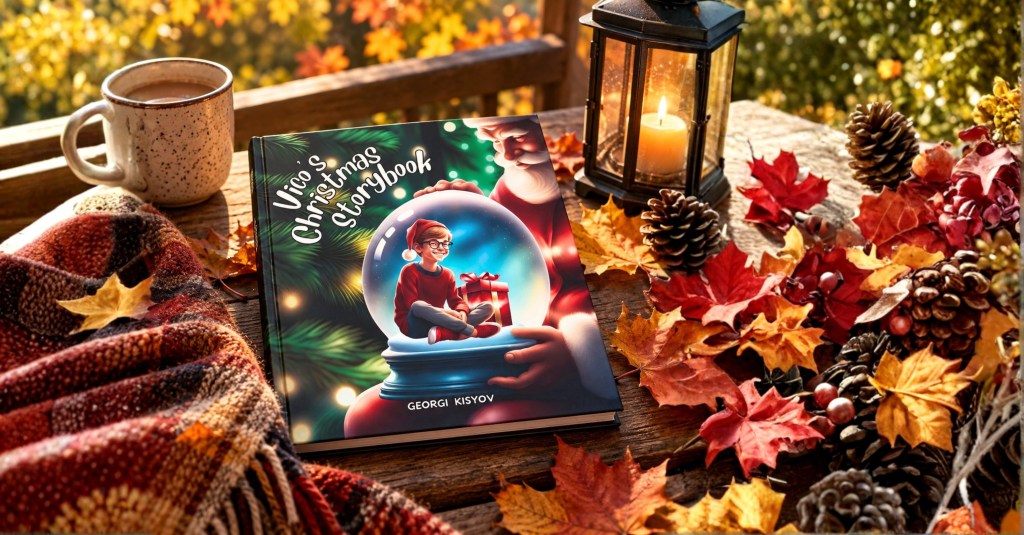
Two years ago, around this time, I was writing my first book.
I had absolutely no idea where those pages would take me.
It was the autumn of 2024, and the book was Vico’s Christmas Storybook. I had never written a book before. I didn’t know much about publishing, formatting, promotion, or all the other things that eventually become part of an author’s world.
At that moment, none of those things mattered very much.
I was simply writing.
And there was something wonderful about that.
When Memories Became Stories
The stories in the book were inspired by real Christmas memories from my family. I didn’t want to simply write down exactly what had happened. I wanted them to feel like children’s stories, so I added a little magic.
But underneath that magic, our memories remained.
I would finish a story and then go back and read it.
Almost every time, my eyes filled with tears.
The stories weren’t sad. Those tears came from somewhere completely different.
I recognized us.
I recognized moments we had lived together. Memories that had existed only inside my head had suddenly become words on a page. I could read them. I could return to them. Most importantly, my son would be able to return to them one day too.
It was an extraordinary feeling.
I had known those memories for years, but I had never read them before.
Writing changed the way I saw them.
The First Time I Saw Vico
Then came another moment that made the book even more personal.
I needed Vico.
I opened Canva and began creating the character. I wrote a description of the little boy I wanted to see.
Except I wasn’t really inventing a little boy.
I was describing my son.
Then Canva created the image.
I still remember the feeling when I saw him.
There was Vico.
Of course, I knew that I was looking at a generated illustration. But that wasn’t what mattered to me in that moment. I looked at the boy on the screen and saw my son.
Something clicked.
Until then, I had been writing my first book and exploring where the stories might take me. But seeing Vico made everything feel real.
This wasn’t just an idea anymore.
This was Vico’s Christmas Storybook.
This was exactly the book I wanted to write.
And perhaps I needed that moment. When you are doing something for the first time, there is always a little uncertainty hiding behind the excitement.
Can I really do this?
Can I finish an entire book?
Will these stories become what I imagine them to be?
Seeing Vico looking back at me felt like an answer.
Keep going.
And I did.
The Innocence of a First Book
Today, two years later, I know much more about what happens after you write the last sentence.
I know about publishing. Covers. Formatting. Promotion. Websites. Social media. Reviews. All the little decisions that come with putting your work into the world.
Back then, I knew very little about any of it.
And strangely, I think there was something beautiful about not knowing.
There was no previous book to compare this one with.
I couldn’t ask myself whether it was better than my last book, because there was no last book.
There were no expectations based on what I had done before.
There was only a blank page and the excitement of putting another story onto it.
Sometimes I probably wondered whether I could really call myself a writer.
Maybe many people writing their first book feel that way.
When does it happen?
When you start writing?
When you finish the manuscript?
When the book is published?
I don’t know if there is one correct answer.
But looking back now, I think I became a writer somewhere during those quiet days of autumn.
Maybe it happened while I was writing one of those family memories.
Maybe it happened while I was reading a finished story with tears in my eyes.
Maybe it happened when I saw Vico for the first time and thought, There he is.
Or maybe it happened little by little, one page at a time.
You Only Get One First Book
I can look at Vico’s Christmas Storybook today and see things I might do differently.
Of course I can.
Two years have passed. I have learned. I have changed. My writing has changed too.
That is exactly how it should be.
But I wouldn’t change the experience of writing that first book.
Because you can improve your writing.
You can learn more about publishing.
You can write another book, and another after that.
But you can never write your first book twice.
You can never completely recreate that mixture of uncertainty, excitement, discovery, and the slightly unbelievable thought:
Am I really doing this?
Perhaps that is one of the reasons I love autumn.
When the season returns, somewhere among the cooler mornings and changing leaves, I remember another autumn.
I remember a computer screen.
I remember family Christmas memories becoming stories.
I remember tears in my eyes.
And I remember seeing a little boy called Vico looking back at me for the first time.
Autumn 2024 gave me my first book.
But it gave me something else too.
It was the autumn when I discovered that I was a writer.
GK


I really enjoyed this Georgi. There is something about a first book that has very little to do with whether it is technically our best work. It captures the version of us who was brave enough to begin before we knew everything that could go wrong. Later we learn about formatting, marketing, reviews, algorithms, and approximately 847 other things nobody bothered to mention when we innocently decided, “I think I’ll write a book.”
But I think the most beautiful part of your story is that you didn’t simply preserve memories—you discovered something about yourself while preserving them. Somewhere along the way, the question changed from “Can I really do this?” to “I am a writer.” That is one of the gifts of beginning something new: sometimes we don’t discover what we are capable of until we are already doing it.
And years from now, Vico may see something in that first book that you cannot see when you look at it with an author’s more experienced eyes. You may notice what you would revise. He may simply see how much his father loved him. I suspect that will be the part that never needs editing.
LikeLiked by 3 people
Thank you so much for this thoughtful comment. You described something I didn’t fully understand when I began—the innocence of starting before knowing about those “847 other things.” And your last thought really touched me. I may always see the things I could improve, but if one day my son looks at that book and simply sees how much his father loved him, then it will have done something far more important than being perfect.
GK
LikeLiked by 2 people
Thanks for sharing this encouragement. My own first book still sits on the computer screen. I keep coming up with reasons not to make that final jump into a published work.
LikeLiked by 2 people
I completely understand that hesitation. Sometimes finishing the writing feels easier than taking that final step and letting the book belong to the world too. I hope one day you make that jump—your book has already come too far to spend its whole life on a computer screen.
GK
LikeLiked by 2 people
I agree. I’m just stuck and don’t know quite why.
LikeLiked by 1 person
I love this essay. You are absolutely right – one can only write a first book once.
And yes, you ARE a writer.
Ceci Snow imagesbyceci@gmail.com
Website: http://www.imagesbyceci.com
>
LikeLiked by 2 people
Thank you so much! That first book will always hold a place that no other book can take. And hearing “you ARE a writer” means a lot to me.
GK
LikeLiked by 1 person
Thanks
For liking my post ‘Common’ 🌹 🙏
LikeLiked by 1 person
This is beautiful, as there really is a simple joy in writing your first book and not knowing anything but your story and the pages. I for one, can relate to that. Often I’m not even quite sure where the story itself is going, but perhaps that’s part of the ride. (Or a slight lack of planning on my behalf)
LikeLiked by 1 person
Thank you so much! I can definitely relate to that feeling of not always knowing exactly where a story is taking you. Sometimes I think that little bit of uncertainty is part of the magic—you discover the story while you’re writing it. And with a first book especially, there is something wonderful about simply having the story and the pages, before you know about everything that comes afterward.
GK
LikeLiked by 1 person
Currently my online book club, Chapter Chats, and I are reading a book I wrote in 2011. My writing is so much different now and I usually have a hard time re-reading the older stories because I become nitpicky about the craft, the writing itself.
But who I was in 2011 is not the same Tiffini I am today. Surprisingly, I’m finding that I’m enjoying this read through of a very early book because it reminds me of exactly how far I’ve come since then – and how publishing with very little understanding of the mechanics of publishing meant I was simply saying, “here’s a piece of my heart.” It’s a kind of vulnerability that is truly special.
LikeLiked by 1 person
I completely understand this. I think that is the gift of looking back at our earlier work—we may notice everything we would change today, but those pages also preserve exactly who we were when we wrote them. I love your words, “here’s a piece of my heart,” because perhaps that innocence and vulnerability are what make our earliest work so special. And what a beautiful way to see how far you’ve come.
GK
LikeLiked by 1 person