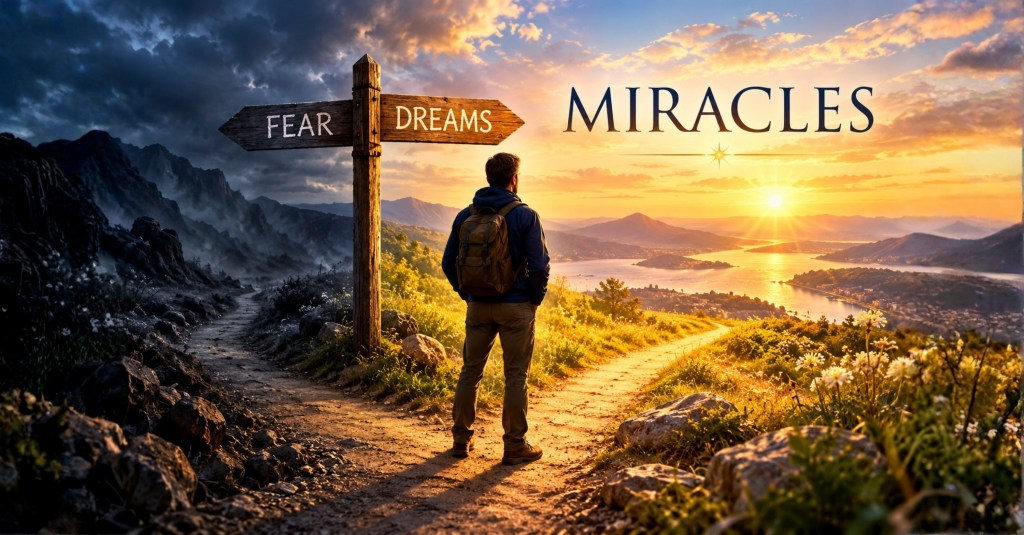
I used to think miracles had to be something extraordinary.
Something impossible suddenly becomes possible. A door opens from nowhere. Life changes overnight. We are standing in one place today and somehow wake up in a completely different life tomorrow.
Maybe miracles can happen that way.
But the older I get, the more I think some of the most important miracles begin much more quietly.
Sometimes they begin inside our own minds.
The human mind is a powerful engine. Every day, we fuel it with our thoughts, attention, imagination, and energy.
Unfortunately, many of us spend an enormous amount of that energy on fear.
We imagine everything that could go wrong.
We replay conversations that haven’t even happened. We prepare ourselves for rejection before anyone has rejected us. We imagine failure before we have taken the first step.
What if I fail?
What if they say no?
What if I embarrass myself?
What if I make the wrong decision?
What if everything goes wrong?
Fear is very good at asking questions.
And somehow, we often treat those questions as facts.
But fear is usually telling us a story about a future that hasn’t happened yet.
And then one day I realized something.
Our dreams are doing exactly the same thing.
They are also showing us a future that hasn’t happened yet.
The difference is that one future is built around everything we are afraid of losing, while the other is built around everything we might be able to create.
So why do we give fear so much more power?
Why does “What if I fail?” sound realistic, while “What if I succeed?” sometimes sounds naive?
Why is imagining disaster called being careful, while imagining something beautiful is sometimes called dreaming too much?
Perhaps we need a little more balance.
If you spend ten minutes imagining everything that could go wrong, give yourself permission to spend a few minutes imagining what could go right.
When your mind asks, “What if I can’t do this?” answer it with another question:
“What if I can?”
This doesn’t mean pretending that difficulties don’t exist. It doesn’t mean that every dream will come true simply because we believe in it. Life doesn’t work that way.
It means refusing to let fear be the only voice discussing your future.
I can see this very clearly when I look at my own life.
If I hadn’t slowly learned to give more power to my dreams, my life today might have been completely different.
Maybe I wouldn’t have started writing.
Maybe the stories that were once only thoughts in my head would never have become books.
Maybe I wouldn’t have believed strongly enough in the possibility of building a different life abroad.
None of those things happened because I suddenly became fearless.
I didn’t.
There were doubts. There were questions. There were moments when the future looked uncertain.
There still are.
Perhaps part of the change comes with age. You begin to understand that waiting until you are completely ready can mean waiting forever. You realize that time is moving whether you take the step or not.
But for me, the bigger change has been personal growth.
At some point, I stopped asking fear for permission.
I started giving my dreams a seat at the same table.
And something changed.
Not magically.
I changed.
When you begin believing that something is possible, you behave differently. You notice opportunities you might have ignored before. You send the message. You write the first paragraph. You apply. You ask. You try.
And then you try again.
Perhaps these are the miracles we sometimes overlook.
Not a mysterious hand opening a locked door for us, but finding the courage to walk toward the door.
Not the perfect person suddenly appearing, but finally being open enough to meet new people.
Not an obstacle magically disappearing, but discovering that we are capable of climbing over it.
The miracle may not be that the world suddenly changes.
Sometimes the miracle is that we do.
And once we change, we begin interacting with the world differently.
You have an incredible amount of creative power inside you.
Think about how much imagination it takes to create a disaster that hasn’t happened yet. Think about how much energy we sometimes spend worrying about tomorrow, next month, next year.
Now imagine giving even part of that energy to something you want to build.
A dream.
A new beginning.
A book.
A different life.
A tiny idea that keeps returning to you.
Don’t spend all your creative power protecting yourself from imaginary disasters.
Pour some of that same passion, intensity, imagination, and belief into what you want to create.
Feed your vision more than your doubts.
Give your dreams some of the power you’ve been giving your fears.
Then take one step.
And another.
And another.
Maybe miracles aren’t always flashes of light.
Maybe sometimes they are simply the moment when we stop asking, “What if everything goes wrong?”
And finally allow ourselves to ask:
“But what if something goes right?”
Sometimes the miracle isn’t a door magically opening.
Sometimes the miracle is realizing you finally have the courage to knock.
GK


This made me think about how often courage itself may be part of the miracle. We tend to look for God to remove the uncertainty, open the door, or make the path unmistakably clear before we move. Yet sometimes He does something quieter—He changes the person standing in front of the closed door.
There is a difference between believing everything will go right and believing we can take the next step even when we don’t know how things will turn out. Faith doesn’t always silence the “what ifs”; sometimes it simply gives us something greater to listen to. And looking back, we may discover that the miracle wasn’t merely where the road eventually took us, but who we became because we trusted God enough to begin walking it.
LikeLiked by 1 person
This is such a thoughtful way of putting it. I especially love the idea that sometimes it isn’t the closed door that changes, but the person standing in front of it. Whatever gives us the strength to take that next step without knowing the outcome can become part of the miracle itself.
GK
LikeLike
I loved this! I think there are two parts to every miracle. There is the event itself and there is the change of perspective it can bring. I have watched people receive miracles only to squander them because they do not receive the change of perspective the miracle offers. In such cases the miracle often just becomes a weird serendipitous event which happened in the past or worse it becomes proof that God is capricious.
If however we receive the change of heart or perspective the miracle offers then it becomes a catalyst that opens doorways to whole new realms!
LikeLiked by 1 person
I really like this distinction between the event itself and what it changes within us. Sometimes what happens may last only a moment, but the new perspective it gives us can influence everything that comes afterward. Perhaps recognizing that inner change is part of recognizing the miracle itself.
GK
LikeLiked by 1 person
I think you are right!
LikeLiked by 1 person
What if I can? I once read a book about unexpected tiny miracles and you are absolutely right – a lot of it is a matter of recognizing when they happen.
After a bad horseback riding accident, I was afraid to try again. After several years (I was in my 30s) I decided to try, coached by a good friend. Not only did I get over the worst of the fear, I went on to compete in dressage and to coach other nervous adults. It was a wonderful experience.
Sadly now, due to age related infirmities, I physically can’t ride. But, I can still hang around my friend’s barn and play with her horses.
Ceci Snow imagesbyceci@gmail.com
Website: http://www.imagesbyceci.com
Please Note: Any email containing my photographs may be forwarded, in its entirety, with credit given to Ceci Flanagan-Snow and/or Images by Ceci. However, copying, downloading or using any photograph in any manner without written permission from the photographer is prohibited and a copyright violation. Thank you for respecting my copyright.
>
LikeLiked by 1 person
What a wonderful example of “What if I can?” Ceci. You didn’t just return to something that frightened you—you went on to compete and then helped other nervous adults find their own courage too. And I love that horses are still part of your life in a different way now; sometimes what we love stays with us, even when the way we experience it changes.
GK
LikeLike
“When your mind asks, “What if I can’t do this?” answer it with another question: “What if I can?”
And
“Perhaps these are the miracles we sometimes overlook. Not a mysterious hand opening a locked door for us, but finding the courage to walk toward the door. Not the perfect person suddenly appearing, but finally being open enough to meet new people. Not an obstacle magically disappearing, but discovering that we are capable of climbing over it.”
This is so true that we spend so much time and energy on the downside of the question vs. the up. Great encouragement in this one!
LikeLiked by 1 person
Thank you, Rosie! It’s amazing how naturally our minds can build an entire story around what might go wrong, while we rarely give the same time to what might go right. I’m learning that the possibility deserves a voice too—not because everything will work perfectly, but because we’ll never discover what we’re capable of if fear always answers first.
GK
LikeLiked by 1 person
Thanks.
Tomorrow. I need the courage to challenge a public authority,
on behalf of vulnerable people unable to speak for themselves.
LikeLiked by 1 person
That sounds like an important moment tomorrow. I hope you find the courage and clarity you need to speak up for those who cannot speak for themselves. Wishing you strength and a fair hearing.
GK
LikeLike
thank you so much for this!!!
LikeLiked by 1 person
Thank you so much. I appreciate your kindness and support.
GK
LikeLike
Love this!
LikeLiked by 1 person
Thank you very much. Appreciate it.
GK
LikeLike
We do tend to listen too attentively to our amygdala, that pesky region of the brain that augments potential consequences, and not enough to ventral tegmental which tells us the reward is worth the risk.
LikeLiked by 1 person
That’s such an interesting way to look at it! Our brains can be very convincing when they’re warning us about everything that might go wrong. Sometimes we need to deliberately give a little more attention to what might be waiting for us if we take the chance.
GK
LikeLiked by 1 person
What a great write-up.
“May your choices reflect your hopes, not your fears.”
Nelson Mandela.
LikeLiked by 2 people
Thank you! That quote fits the heart of this reflection beautifully. Our fears may always have something to say, but I love the idea of allowing our hopes to have the stronger voice when we make our choices.
GK
LikeLiked by 2 people
I love this. Miracles are from the hand of God. He gets the glory. Whether by Him opening that door/idea/opportunity/healing, where there previously was no way that it could’ve come about. Then we respond. As Christians, we rely on the Holy Spirit to drive out fear and bring courage instead.
I’ve witnessed those subtle miracles you describe. But have also seen the sudden miracles, working as a nurse. Things for which there’s simply no explanation. Other than the Lord.
Hope that makes sense.
LikeLiked by 2 people
It absolutely makes sense, and thank you for sharing your perspective. I can imagine that working as a nurse has allowed you to witness moments that stay with you for a lifetime. I really appreciate your distinction between the quiet miracles that change something within us and those sudden moments that seem to have no explanation.
GK
LikeLiked by 2 people