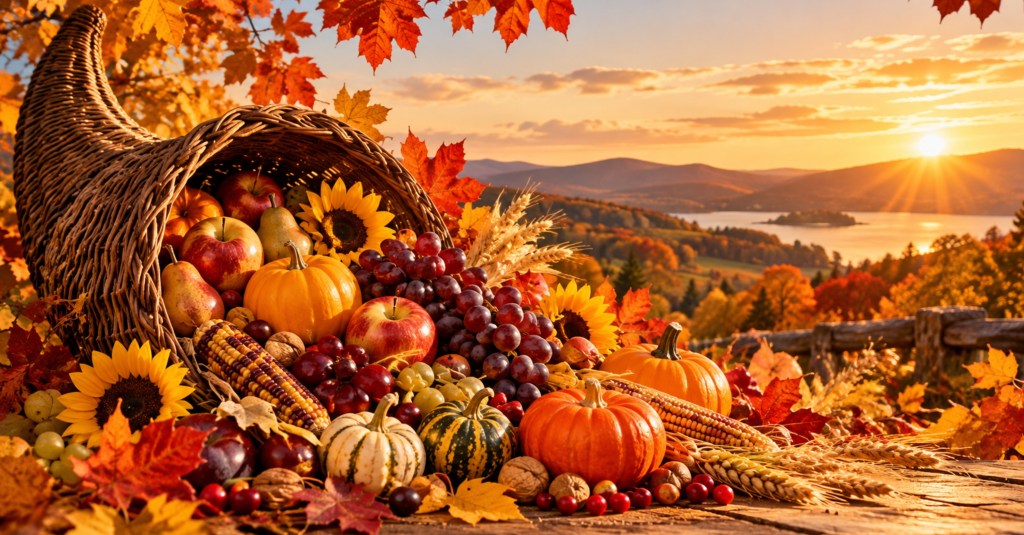
There is a quiet moment in autumn when everything feels full.
Not loud. Not hurried. Just full.
The trees linger in their colors a little longer, the fields rest after their long work, and the air carries the gentle weight of something completed. In this stillness, the image of the cornucopia appears—not as decoration, but as a feeling. A quiet presence. A reminder.
The old “horn of plenty” rests at the heart of the season. Curved, open, and overflowing, it does not ask to be noticed, yet it gathers attention without effort. Fruits spill from its mouth as if they cannot be contained—apples, grapes, squash, grains—each one shaped by time, touched by sunlight, and carried here by unseen hands.
It is more than a symbol of harvest.
It is a symbol of generosity.
Not the kind we plan or measure, but the kind that simply gives.
If you follow its shape, the cornucopia tells a story. It begins narrow, almost modest, then slowly opens, widening without hesitation. Like a breath that starts quietly and grows into fullness. Like the way life gathers itself, unseen at first, until it can no longer remain hidden.
All summer, the world has been preparing for this moment.
The sun has offered its warmth without keeping count.
The soil has held and nourished without asking to be seen.
The rain has come and gone, steady and patient.
Nothing rushed. Nothing demanded applause.
And then, in autumn, everything arrives.
Not arranged. Not measured.
But abundant.
The harvest does not come in perfect lines or equal portions. It comes as a joyful overflow—a gathering of colors, shapes, and textures. Some fruits are smooth, others rough. Some glow brightly, others carry the softness of shadow. There are marks, bends, and imperfections everywhere, and yet together they create something whole.
Nature does not strive for perfection.
It offers fullness.
There is something deeply comforting in that.
Because it reminds us that life is not meant to be controlled down to the smallest detail. It is meant to be lived, gathered, and shared—just like the harvest itself.
Autumn, in its quiet wisdom, becomes a season of giving.
But not in the way we often understand it.
This is not about holding tightly to what has been gained. It is about letting it move. About allowing what has grown to be used, to be tasted, to pass gently from one hand to another. The earth does not store its beauty away out of fear that it might disappear. It offers it freely, trusting the rhythm that has always carried it forward.
There is a quiet courage in that.
A kind of trust.
The horn does not fear becoming empty.
It understands something we often forget—that emptiness is not an end, but a beginning. A space where something new will quietly take root again.
And this is where its meaning touches our lives.
We are often taught to think in terms of scarcity. To hold on. To measure carefully. To protect what we have, just in case there is not enough later. We build invisible walls around our time, our energy, even our kindness.
But the earth shows us another way.
There are seasons for gathering—and seasons for giving. Fullness is not meant to stand still. What we receive is meant, in some gentle way, to continue its journey.
A meal shared.
A kind word offered.
A moment of patience, given when it would be easier to turn away.
These are the quiet ways abundance moves through us.
They do not need to be perfect to matter.
They simply need to be given.
There is also a quiet humility in the cornucopia, easy to overlook.
Because when we see its abundance, it is tempting to feel as though it belongs to us—that we have earned it, created it, secured it. But the truth is softer. None of us asked the sun to stay a little longer. None of us called the rain when it was needed. None of us shaped the seed in the darkness of the soil.
We participated, yes.
But we did not create the miracle.
In many ways, we are guests at a table that was prepared long before we arrived.
And there is peace in accepting that.
It softens the need to control everything. It allows us to receive what is given and respond with gratitude—not loud, not performed, but quiet and steady. The kind of gratitude that changes how we see, how we speak, how we move through the world.
As autumn slowly leans toward winter, the fullness begins to fade.
Leaves fall. Fields empty. The bright colors soften into browns and quiet golds. The cornucopia will not remain overflowing forever.
But that does not lessen its beauty.
If anything, it deepens it.
Because it reminds us that abundance is not something we can hold onto. It is something we are invited to notice, to appreciate, and to share while it is here.
Perhaps this is the deepest lesson hidden in the gentle curve of that ancient horn—
that life is not measured by how much we keep, but by how much we allow to pass through us.
Autumn does not cling to its riches.
It opens its hands.
And in that simple gesture, it shows us what it means to live with a quiet, boundless generosity.
GK


