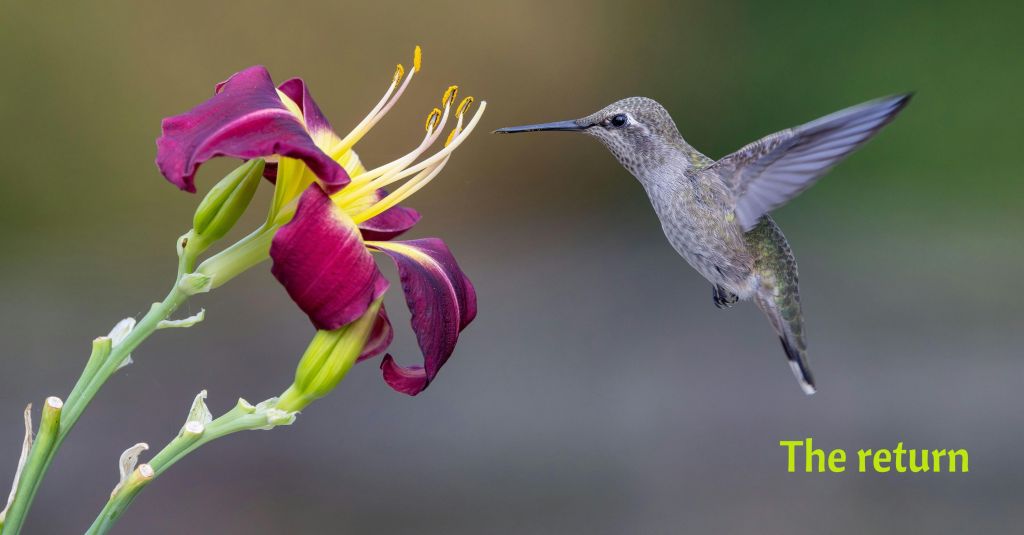
There is a quiet moment every spring that many of us almost miss.
It doesn’t arrive with thunder or celebration. It doesn’t announce itself loudly like the first warm day or the sudden bloom of trees. It comes softly—on wings so small they seem impossible.
The hummingbirds return.
And with them, something inside us begins to move again.
After a long Canadian winter, when the world feels paused and our thoughts grow heavier than we admit, the return of the hummingbird is more than a seasonal event. It is a reminder. A gentle, living proof that life does not forget its way back.
The Audacity of Smallness
The hummingbird is almost unreal.
A tiny body. A heart beating faster than seems possible. Wings that blur into invisibility. And yet—this fragile creature travels thousands of miles, crossing entire continents to return to the same places, the same gardens, the same quiet corners of the world.
It makes you wonder.
How does something so small carry so much strength?
We often measure ourselves by size—by how big our problems are, how far our goals seem, how heavy our struggles feel. We look at the distance ahead and quietly doubt whether we have what it takes.
But the hummingbird does not ask those questions.
It simply flies.
Its return reminds us that strength is not always loud or visible. Sometimes it lives in the smallest parts of us—the quiet hope we protect, the love we continue to give, the dreams we refuse to abandon.
What looks fragile is often the most resilient.
The Geometry of Presence
There is something mesmerizing about watching a hummingbird hover.
Unlike other birds that glide or rest, the hummingbird exists in a constant state of motion just to remain still. Its wings beat rapidly, almost invisibly, holding it in one perfect place as it drinks from a flower.
From the outside, it looks effortless.
But it is not.
It is one of the most demanding acts in nature—a perfect balance between motion and stillness.
And maybe that is where its deepest lesson lives.
We often think that being present means slowing down, doing less, stepping away from the noise. But the hummingbird shows us something different. Presence is not the absence of movement—it is the intention behind it.
We can be busy and still be present.
We can be moving and still be grounded.
The question is not how fast we go, but why.
Are we rushing through life, or are we choosing where to place our energy?
The hummingbird does not hover everywhere. It chooses its flower. It commits to that moment fully.
There is wisdom in that.
The Resurrection of Joy
In many cultures, the hummingbird is seen as a symbol of joy—pure, light, and fleeting, yet deeply meaningful.
And its return feels exactly like that.
After months of cold, of gray skies and quiet days, something shifts. The air softens. The colors begin to return. And then, suddenly, there it is—a small flash of life, reminding us that winter never has the final word.
We all have winters.
Not just the ones outside our windows, but the ones inside us—the seasons when everything feels still, when joy seems distant, when we move through our days more out of habit than excitement.
The hummingbird does not erase those winters.
But it interrupts them.
It reminds us that joy does not need to arrive in big, dramatic ways. Sometimes it returns quietly:
In a moment of laughter we didn’t expect.
In a memory that warms us instead of hurts us.
In a simple feeling that things might be okay again.
It invites us to begin again, not all at once, but gently.
To look for sweetness in small places.
To revisit the things we once loved.
To trust that what felt lost is often just resting.
An Anchor of Hope
There is something deeply comforting about knowing that hummingbirds return every year.
They do not stay away because the journey is long.
They do not give up because the distance is difficult.
They return because something calls them back.
Because the destination matters.
And maybe that is the quiet truth they carry for us.
We are not meant to stay in our winters forever.
No matter how far we feel we’ve drifted, no matter how heavy the season has been, there is always a path back—to warmth, to color, to life.
The hummingbird does not return because the journey is easy; it returns because the destination is worth the flight.
And so are we.
The Invitation
The return of the hummingbirds is not just something to observe.
It is something to receive.
It is an invitation to trust ourselves again.
To believe that even the smallest parts of us are strong enough to begin again.
To remember that life is always moving, even when we feel still.
One day soon, you may see one.
Just for a second—a blur of wings, a flicker of light.
And then it will be gone.
But if you pause, if you really look, you will feel it:
That quiet shift inside you.
The return has already begun.
GK


Well I won’t see a hummingbird soon! Humming birds are way beyond my experience here. I didn’t know they visited Canada. I recognise the sudden, unexpected return of joy, which can be fleeting but all encompassing.
We are not meant to stay in our winters.
Thank you.
LikeLiked by 3 people
That’s such a beautiful reflection—thank you for sharing it. Even without seeing a hummingbird, you’ve captured its meaning perfectly. That sudden return of joy… small, unexpected, but filling everything for a moment—that’s exactly it. And yes, we are not meant to stay in our winters. 🌿
GK
LikeLiked by 1 person
The creature is a paragon of efficiency and simple beauty. I love your image, buddy.
LikeLiked by 1 person
Thank you, my friend—that means a lot. 😊
I love how you put that… a paragon of efficiency and simple beauty. There’s something so pure in that kind of design—nothing extra, just exactly what it needs to be.
I’m really glad the image spoke to you. 🌿
GK
LikeLike
“Our” hummingbirds don’t usually arrive here on the east coast of Canada until around May 10th, when the weather is more predictably warmer. However, according to a site I follow, they’ve been moving north earlier and more rapidly than in previous years, probably due to the increasing heat in the midwest.
Just in case, I put our two feeders out so they can get a drink when they get here. I change the contents every day or two (depending on the weather) and thoroughly enjoy their antics.
I miss their wonderful antics when they head south for the winter and our yard is populated with vociferous blue jays who bully smaller birds away. But, the chickadees are persistent and return day after day for whatever they can find in the feeders that the jays haven’t confiscated.
As the days lengthen and become warmer, it really helps to improve my mood and mental health. The warmth of the stronger sun on my face makes me smile – something that I found hard to do in the cold mid-winter.
For now, I’m happy to see a pair of geese that have returned to Mud Lake to raise this year’s batch of gosling.
LikeLiked by 1 person
This is such a beautiful picture of the changing seasons—thank you for sharing it. 🌿
I love how attentive you are to their arrival, putting the feeders out early, almost like a quiet welcome home. There’s something so special about that care… like you’re part of their journey in a small, meaningful way.
And I felt that contrast too—the lively hummingbirds, the bold blue jays, the steady little chickadees… each one bringing its own rhythm to your yard. It’s like a living story unfolding day by day.
What you said about the sun and the shift in mood really stayed with me. That first real warmth after winter… it does something deep inside us. I’m so glad you’re already seeing those early signs—geese returning, life beginning again.
It’s all slowly coming back. 🌞
GK
LikeLike
In some Indigenous cultures hummingbirds symbolize joy. Little whirriing buzzes of joy. I was once sitting outside on my deck in upstate NY wearing a floral top and I thought I heard a bee coming towards me. It was hummingbird coming to check me out hovering right in front of my face. A moment of joy. My grandmother always used to say, “thank goodness for small mercies.” Right she was. Thank you as always.
LikeLiked by 1 person
What a beautiful story—thank you for sharing that. 🌿
I love that image… a tiny hummingbird mistaking you for a flower, hovering right in front of you like a little spark of joy. Moments like that feel almost like a gift, don’t they?
And your grandmother was so right—those small mercies often carry the biggest meaning. I’m really glad this piece brought that feeling back to you.
GK
LikeLike
I like your writing style. Simple and interesting!👌
LikeLiked by 2 people
Thank you so much—that truly means a lot to me. 😊
I always try to keep things simple, but meaningful… so I’m really glad it resonates with you. 👌🌿
GK
LikeLiked by 1 person
“We are not meant to stay in our winters forever. No matter how far we feel we’ve drifted, no matter how heavy the season has been, there is always a path back—to warmth, to color, to life.” And
“Just for a second—a blur of wings, a flicker of light. And then it will be gone. But if you pause, if you really look, you will feel it:
That quiet shift inside you. The return has already begun.”
Love how you’ve described this “quiet shift” as the hummingbird. A truly wonderful post full of quiet moments and hope. You take the ordinary and turn it into magic moments to seek and hold dear. Hold them close friend – it is clear the water is breaking for you. ~ Rosie
LikeLiked by 1 person
Rosie… thank you. 🌿
The way you held those lines and reflected them back means so much to me. You felt that “quiet shift” exactly as I hoped it would be felt—not loud, not overwhelming, just something gentle that finds its way in.
And your words at the end… I’ll carry them with me. Truly.
Grateful for you, always. 💛
GK
LikeLiked by 1 person
“…No matter how far we feel we’ve drifted, no matter how heavy the season has been, there is always a path back—to warmth, to color, to life.”
This almost felt fated to read. I’d been in an uneasy state since yesterday, and this was like a breath of fresh air. It’s true; no winter could last long, no matter how cold it gets.
Thanks for the reminder🤍
LikeLiked by 1 person
Thank you for sharing this 🤍
I’m really glad these words found you at the right moment… sometimes we don’t need answers, just a small breath of fresh air to remind us where we are.
And you’re so right—no winter lasts forever, no matter how it feels while we’re inside it.
Wishing you a little more light and ease today 🌿
GK
LikeLiked by 1 person
Profound and true. I wished i could show you the beautiful hummingbirds feeder outside my kitchen window, a gift from my son that I truly cherish.
I see the Anna’s and Rofus most often and when they come to feed, I find myself holding my breath not moving an inch because I don’t want to frighten them away but even more because I’m so in awe of these beautiful little creatures so determined so strong while soaring so fragile.
The sound of their wings as they hover so delicate you probably wouldn’t notice if you weren’t watching.
I am surrounded by many items humming bird thanks to my family who know how much I treasure them.
I particularly found your words “the hope we protect, the love we continue to give, and the dreams we refuse to abandon” the most heartwarming touching humbling and valuable of all… like the gentle strength and quiet resolve of hummingbirds who know their path, stay the course, and may falter but never waver on that which is important.
True too that it isn’t always the large imposing moments of growth and expansion of horizons, but those delicate quiet moments of introspection observation and fragile moments whispered on air that carry us the distance, to peace fulfillment even opportunity.
So with humble heart I thank you for yet another moment thought and reflection on which to ponder. For I truly do love hummingbirds their delicacy strength determination and life well lived even if too short. Brava for this. Truly.
LikeLiked by 2 people
This is so beautiful… thank you for sharing it with me. 🌿
I could picture you there by the window, holding your breath, completely still… not wanting to disturb that tiny moment of wonder. There’s something sacred in that kind of attention, isn’t there? The way we become quiet just to be present with something so small, yet so powerful.
And I love how you described them—fragile, yet so determined. That contrast holds so much truth, not just about them, but about us too. The strength we carry quietly, the paths we follow even when they’re not easy…
It means a lot that those words stayed with you. Truly.
Thank you for receiving this piece with such an open heart—and for reflecting it back in such a thoughtful, beautiful way.
GK
LikeLiked by 1 person
I always look forward to the arrival of my hummingbird friends each spring and summer. You reminded me beautifully of their fragility and resilience, their determination to reach their destination. This gives me hope that I, too, can find my inner hummingbird and get through the obstacles in my way.
LikeLiked by 1 person
That’s so beautifully said—your hummingbird friends. 🌿
I love that… and I truly believe you already carry that “inner hummingbird” within you.
That same quiet strength, that determination to keep going, even when the path isn’t easy—it’s already there.
I’m really glad this piece brought you that sense of hope.
GK
LikeLiked by 1 person
Thank you, my friend, for believing in me, it means a lot. 🙏🏽
LikeLiked by 1 person
There’s something in this that just settles gently into the heart. That picture of the hummingbird—so small, yet so faithful in its return—feels like a quiet whisper that strength and hope don’t have to be loud to be real. I love how it reminds us that even when life feels still or heavy, something is always moving beneath the surface, preparing to bloom again.
I find myself thinking about the hummingbirds that swirl around the feeder just outside my window, and the finches that gather in such cheerful clusters at the feeder hanging from the tree out back. There’s something about watching them—so alive, so purposeful, yet so light—that makes my heart sing in a way I can’t quite explain. It’s like they carry a little piece of joy with them, and just by being there, they share it.
LikeLiked by 1 person
This is so beautifully expressed… thank you for sharing it. 🌿
I love how you described it as something that “settles gently into the heart”—that’s exactly the feeling I hoped it would carry. That quiet kind of strength, the kind that doesn’t need to be loud to be real… it’s easy to overlook, but it’s always there.
And your image of the birds around your window… I could feel that. The hummingbirds, the finches, all moving with that lightness and purpose—it really does feel like they bring a small piece of joy with them and leave it behind for us to notice.
I’m so glad this connected with you in that way.
GK
LikeLike
A beautiful post about these amazing big little birds. I live in B.C. where they recently arrived back after their long flights from Mexico. You might enjoy this poem too (or maybe you already know of it): https://allpoetry.com/poem/8510271-Humming-Bird-by-D-H-Lawrence
Cheers.
LikeLiked by 2 people
That’s such a thoughtful share—thank you for this. 🌿
I’m glad you mentioned the poem too. D. H. Lawrence had such a unique way of seeing nature—not just as something gentle, but as something ancient, powerful, almost mysterious. In his “Humming-bird,” he imagines the bird as part of a much older, wilder world—almost like a spark of life itself moving through creation.
It’s beautiful how your comment connects with that same feeling—these tiny birds carrying both fragility and incredible strength.
And I agree… they really are a lovely sight.
Cheers, my friend 🌿
GK
LikeLiked by 1 person
You’re very welcome. My pleasure. 🙂
LikeLiked by 1 person