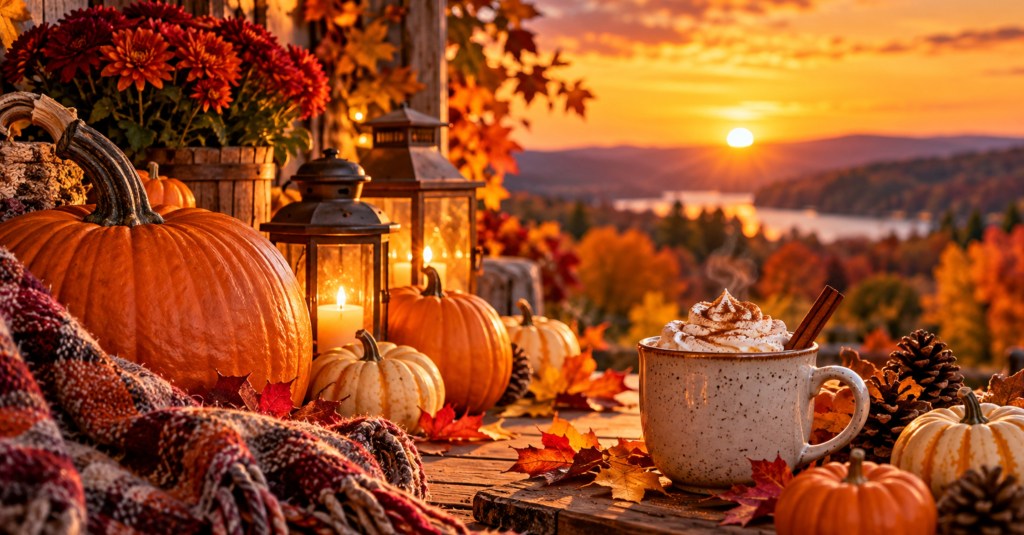
As the green pulse of summer softens into the amber stillness of October, something quietly takes its place at the center of it all. You begin to notice pumpkins everywhere—on porch steps, in market crates, on kitchen counters, even in the cups we hold between our hands. This gentle symbol of the season arrives not loudly, but fully, as if it has been waiting all year for this moment to belong.
A pumpkin rests there, round and steady, like a small sun that has fallen from the sky and chosen the earth instead.
There is something deeply comforting about its presence. Maybe it is the color—this rich, glowing orange that feels like warmth made visible. Or maybe it is the shape, soft and complete, with no sharp edges, no urgency. It doesn’t rush. It doesn’t try to impress. It simply exists, carrying within it the quiet story of time.
Because to look at a pumpkin is to understand that it was not always this way.
Once, it was just a vine stretching across the ground, almost unnoticed. It drank from the summer rains, rested under long, generous days, and grew slowly, without announcement. It did not demand attention while it was becoming. It trusted the season to do its work.
And then, when the light began to change—when the days softened and the evenings grew thoughtful—it revealed its true self.
That’s what autumn does. It doesn’t create something new. It reveals what has been growing all along.
The pumpkin becomes its symbol not because it is perfect, but because it is complete. It carries the weight of months inside its thick skin. It is the earth’s full belly, filled with everything it has gathered before the cold begins to settle in.
And maybe that is why we are drawn to it.
We live most of our lives in the “becoming”—stretching, reaching, growing without always seeing the result. Autumn, through this quiet emblem, reminds us that there are moments when we are allowed to arrive. To be full. To simply exist as we are, without needing to add more.
But the pumpkin holds another, quieter truth.
It teaches us about letting go.
There is a strange kind of beauty in what we do with a pumpkin. We carve it. We open it. We take out everything that once filled it—the tangled pulp, the crowded seeds—and we set it aside. At first, it might feel like loss. Like something is being taken away.
But then, something unexpected happens.
We place a small flame inside.
And suddenly, the hollow space becomes the very thing that allows the light to shine.
It is one of autumn’s gentlest lessons: sometimes, we need to be emptied a little to glow more clearly.
We carry so much through the year—thoughts, worries, expectations, noise. We fill ourselves without even noticing. And then a season like this arrives, not to take from us, but to make room.
This humble pumpkin does not resist the carving. It transforms because of it.
And there is something quietly comforting in that.
Of course, not every pumpkin becomes a lantern. Some find their way into kitchens, where another kind of magic happens. The scent of cinnamon, nutmeg, and warm sweetness begins to fill the air. The house changes—not in its structure, but in its feeling.
You step inside, and suddenly the world feels softer.
A simple pumpkin pie, a warm pumpkin drink, a loaf fresh from the oven—these are small things, but they carry a kind of richness that goes beyond taste. They remind us that comfort doesn’t come from having more, but from noticing what is already here.
The pumpkin becomes part of that language of home.
It is in the way we gather. The way we sit a little longer at the table. The way conversations stretch without needing a reason. Outside, the air may be turning cooler, the trees slowly letting go of their leaves, but inside, there is a quiet fullness that holds us together.
This is what “pumpkin everything” really means.
It’s not just the flavor, or the decorations, or the traditions repeated year after year. It is a feeling we return to. A golden pause before the first frost. A moment where life slows just enough for us to notice it.
There is also something gently nostalgic about the pumpkin.
This season feels familiar, even when life around it changes. It reminds us of past autumns—of doorsteps we once stood on, of hands we once held, of laughter that still echoes somewhere in us. It doesn’t try to bring those moments back. It simply lets them sit beside us for a while.
Like a quiet companion.
And maybe that is why we reach for pumpkins so instinctively.
Because as the world begins to shift toward winter, we feel the need to hold on to something warm, something steady, something that reminds us that fullness once lived here—and can live here again.
A pumpkin does not stop the seasons from changing.
It doesn’t hold back the cold or keep the leaves from falling.
But it teaches us how to stand in the middle of that change with a sense of peace.
To be full when it is time to be full.
To let go when it is time to let go.
To create light, even from what feels empty.
And to gather close, not because we are afraid of what is coming, but because we understand the value of what we have right now.
So when you see pumpkins this autumn—lined up on porches, resting in fields, glowing softly in the evening—pause for a moment.
They are more than decoration.
They are quiet reminders that life moves in cycles, that beauty can be both full and hollow at the same time, and that sometimes, the simplest things carry the deepest meaning.
In a season that asks us to slow down, the answer comes gently:
You have grown.
You have gathered.
Now, just be.
GK


